
This report was originally published in Spanish by Público and has been translated into English for republication as part of the Dirty Data series. Minor edits may have been made to accommodate the translation and ensure clarity for English-language readers.
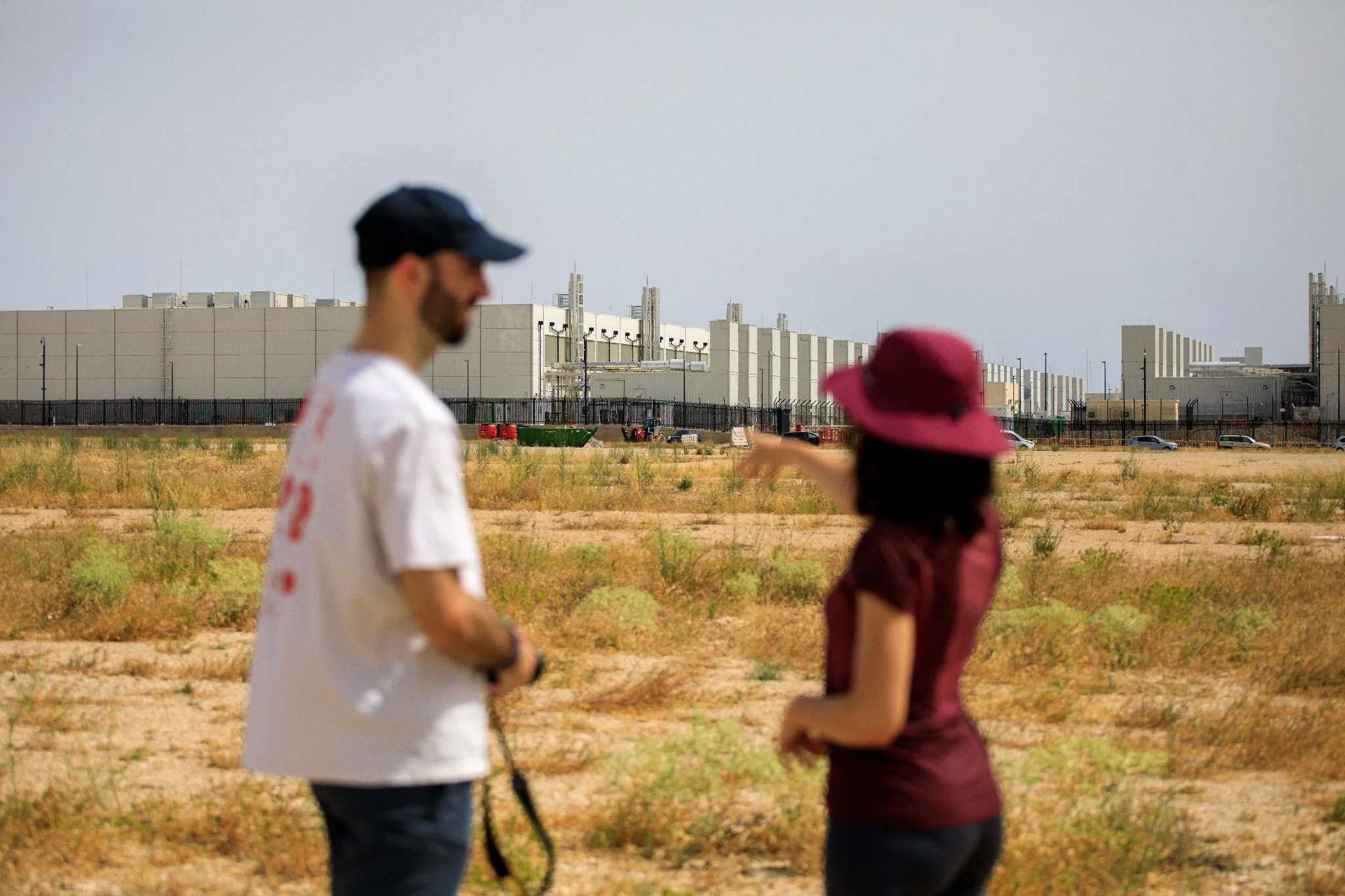
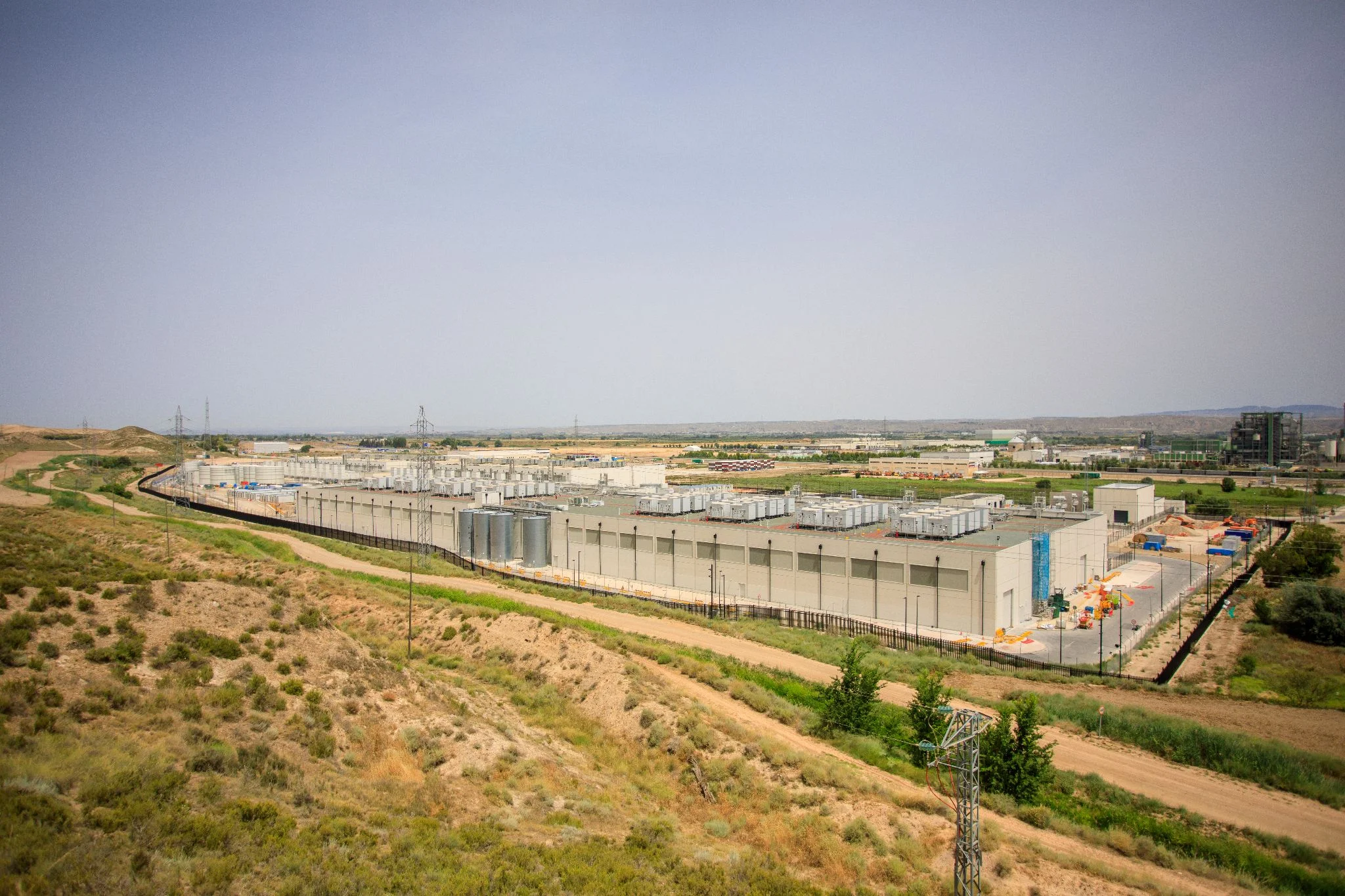
Luis García Valverde and Aurora Gómez celebrated Christmas 2024 in a different way. They spent it poring over hundreds of pages of technical documentation on the enormous project that Amazon is building in Aragón. A network of data centers that the multinational aims to turn, by 2030, into what will likely be its largest physical infrastructure outside the United States.
Eleven complexes – following the latest expansion announced in March – spread across the region, interconnected with one another and designed to power a specific type of artificial intelligence. In particular, text-, image-, and video-generating applications that require enormous amounts of energy and water to operate. And which, at the same time, represent the major strategic focus for tech giants as they seek to continue increasing their record annual profits.
Gómez and Valverde recall those weeks as “hell”. The analysis of those reports led, upon returning from the Christmas break, to several formal complaints against the Amazon Web Services (AWS) complex, the U.S. firm's computing unit. But above all, it planted the seed for a more ambitious project. One which has, over time, crystallized into the first organized movement in Spain against data centers in the generative AI era.
This industry, which is booming worldwide, has found a real goldmine in Aragon. The AWS centers are just the first in a long list of macro-complexes that are set to spring up in the region, with the regional government as their main backer. Another tech giant, Microsoft, already has all the permits to build three new centers.
Major players from the real estate, energy and construction sectors have also joined this development boom. Spanish firms such as ACS, Forestalia, the Azora fund and Merlin Properties, as well as global corporations such as Blackstone, have projects here at various stages of development.
But whilst the arrival of hyperscale data centers had so far gone largely unnoticed in Spain, the social climate seems to be changing. The group to which Gómez and Valverde belong, alongside other activists and researchers, has been standing up to this industry for months, both on the streets and in the courts.

As part of the Dirty Data project, ERC and Público are telling this story for the first time from the inside, drawing on exclusive information and testimonies. This story also reveals new details of the legal action this collective is about to take against the Government of Aragon over the fast-track approval of Amazon’s mega-project.
The power of people's pressure
In May, the authorities in Box Elder, Utah, approved the Stratos project. This AI server complex will occupy an area twice the size of Manhattan and, according to various studies, poses a threat to the Great Salt Lake, which borders the county. Several hundred local residents attended the public hearing in an attempt to halt the project.
Similar scenes have been unfolding across the US for months. Although the residents of Box Elder have not yet achieved their goal, citizens' groups in various parts of the country have already succeeded in halting multi-million-dollar projects. In response to this growing opposition, a long list of local authorities have passed anti-data center legislations.
Bernie Sanders and Alexandria Ocasio-Cortez, leading figures in the progressive wing of the Democratic Party, have taken up the cause, proposing a national moratorium on this industry. For the time being, in Spain, the debate – and the industry's expansion itself – is several steps behind. But for almost a year now, things have been moving in Zaragoza, Aragón's capital city, and the surrounding area.
In September, the streets of the Aragonese capital saw a column of demonstrators march to Plaza de San Pedro de Nolasco, in the heart of Zaragoza's Old Town. The route chosen for the first demonstration against data centers in Spain was no coincidence. The march set off from the Torrero neighborhood, where one of Microsoft's three complexes is to be built, and ended in front of the Aragonese government's Department of the Environment.
"We didn't expect so many people," says Cristina García, more than half a year later.She’s a member of No es sequía, es saqueo (It's not a drought, it's plunder), the group that organized the protest. The group had been set up a few months earlier with the aim of challenging a narrative that, as García points out, had until then been dominated by the companies themselves, the regional government and friendly media outlets.
Since then, the group has been using its social media channels to highlight the dark side of these facilities, denouncing, for example, how the Israeli army has used the Microsoft and AWS cloud services in the genocide in Gaza. Or how these same companies support ICE – the spearhead of Trump's anti-immigration crusade – through these centers.

Another focus of the group is organizing public talks in the municipalities of Aragón where new centers have been announced, as well as activities such as a recent “toxic walk” around the enormous plot of land that Microsoft plans to occupy south of Zaragoza.
Recalling last year's demonstration, García points to the "sense of hope" she felt upon seeing that her first public call to action had not fallen on deaf ears. "I remember thinking that all of us who were there could replicate what's happening in the U.S.,” she says, referring to the “people's power" that has already managed to halt several projects.
Data center construction companies know that a key aspect of their business is finding authorities willing to fast-track projects involving highly complex infrastructure. This ranges from a connection to a power source capable of quenching their immense thirst for watts, to reliable communications in the event of a crisis, to available land that guarantees their ability to expand.
The case in Aragon is paradigmatic in this regard. The Azcón administration is processing all the complexes mentioned in this story through the PIGA (Project of General Interest) framework, an administrative category reserved for investments of “special significance” to the region. This entails, among other benefits, tax incentives, prioritization over other initiatives, and shorter processing times.
A groundbreaking lawsuit in the making
In August 2025, Jorge Azcón’s government approved the PIGA for AWS’s first expansion project, which includes five complexes in various Aragonese municipalities. The government’s final authorization did not require the company to make substantial changes to the project, as several of the organizations that filed objections had requested.
This massive project is a sort of vanguard for this industry in Aragón –since late 2022, AWS has operated three smaller data centers, currently under expansion. And nearly all the figures around it are unprecedented. Just one of the eleven complexes currently proposed by the company is expected to consume 16.5% of the region’s total energy usage, and the combined output of all of them is expected to far exceed the current demand for the entire region of Aragon.
The figures regarding water are equally a source of concern, particularly given the company’s efforts to conceal its impact on water resources and the lack of transparency it has demonstrated regarding its facilities in Spain.
Luis Valverde, of Ecologistas en Acción, and Aurora Gómez, of Tu Nube Seca Mi Río, recall that once the appeal process had been exhausted, they discussed internally their next steps. Together with the group of academics accompanying them through this process—including researcher Enol Nieto (Universidad de Vic)—they then decided to give shape to an idea that had been on their minds for some time. To take the regional government to court over the way it has handled this mega-project, which the former label “illegitimate.”
“They turn a deaf ear to concerned citizens and bypass democratic processes,” says Gómez, highlighting the shortened public participation deadlines associated with the PIGA.
Valverde notes that at that point, they ran into two major obstacles: how to finance the legal proceedings and how to find lawyers willing to take on the case. That’s when the group decided to launch a public crowdfunding campaign, which in just six days reached the minimum goal of 7,300 euros.
The chosen funding method, explains the environmentalist, not only resolved the financial issue but also sought to raise awareness of their cause and allowed them to gauge the extent to which people were interested in supporting it. “Faced with a PIGA that isn’t really in the general interest of Aragón, we were able to demonstrate what the true interests of the people of Aragón are,” he notes.
“We’re constantly drawing inspiration from other countries and groups, even from other eras,” adds Gómez, referring to the successful crowdfunding experiences of the British organization Global Action Plan, which specializes in social and environmental litigation.
Once the team in Aragón had successfully overcome the financial hurdle—the campaign ultimately raised 15,000 euros—they found the legal support they needed with the Fons de Defensa Ambiental, a small Barcelona-based association specializing in environmental litigation.
Amazon Makes a Move
The legal team handling the case filed an administrative appeal against the Aragonese government in January, the preliminary step before filing a lawsuit. A few weeks later, the High Court of Justice of Aragon (TSJA) accepted the appeal for consideration, thereby opening a period—still ongoing—to review the massive case file associated with this multimillion-euro project.
Meanwhile, Amazon has not been sitting idly by. According to information obtained by Público from sources familiar with the proceedings, the company filed a motion for reconsideration—which has already been dismissed by the TSJA panel—against the high court’s decision to accept the administrative appeal, arguing that it had been filed after the deadline.
These same sources indicate that the company has also opposed the prosecution's request to expand the case file, which would allow the inclusion of reports on all the facilities the multinational has made public to date.

A company spokesperson acknowledged that AWS has been involved in “some of the procedural steps” of the case but declined to provide further details, as legal proceedings are ongoing.
AWS also stated that “its primary goal” is “to be a committed neighbor to the communities” where it operates. “To that end, we are in constant contact with various social and economic stakeholders in the region, including neighborhood associations, environmental groups, labor unions, public and administrative institutions, as well as local business organizations, among others,” they stated. “As a result of these collaborations, various community projects have emerged focused on STEM education, environmental protection and stewardship, economic development of the local business community, innovation, and technology, among other areas.”
The Aragonese government, for its part, argues that it has “acted in accordance with the law” and states that it is prepared “to defend its governmental actions in the appropriate forums.” When also asked about a possible rapprochement with the civil society organizations filing the lawsuit, sources within Azcón’s administration stated that “neither a rapprochement nor the opposite.”
“The appropriate course of action is to respond to the legal proceedings by addressing the issues raised by the plaintiffs,” they replied in writing to this publication.
Legal scholar Mireia Orra de Salsas points out that, from a legal perspective, the ongoing litigation in Aragón represents a highly innovative strategy in the Spanish context. Unlike traditions such as the Anglo-Saxon one, where a single favorable ruling can establish case law for similar cases, the path here is more complex. “Winning a lawsuit can help, but that’s all.”
Orra de Salsas, who also highlights the significant amount of “time and resources” these proceedings require, has been directly involved in recent years in several strategic lawsuits in Spain challenging various forms of technological abuse. One of these was the complaint against the Universitat Oberta de Catalunya (UOC) regarding the use of facial recognition, which in 2022 resulted in a fine from the Catalan data protection agency.
This case, explains the lawyer—now a member of the DonesTech collective—illustrates how these proceedings can drag on for years. Following the initial fine, the litigating parties filed a lawsuit against the Catalan agency for excluding them from the proceedings. More than three years later, that lawsuit remains unresolved. “The case in Aragon is going to be a long one,” concludes this expert.
An unbalanced force and an ambitious goal
“When people rise up, empires fall.” American journalist and author Karen Hao concluded her opening talk a few weeks ago at re:publica—one of Europe’s leading conferences on technology and rights—with these words.
In her recent book Empire of AI: Dreams and Nightmares in Sam Altman's OpenAI, Hao uses the metaphor of empires to dissect the power structures that AI giants are building across the globe, including data centers. But she also points out how growing public resistance around the world can undermine even the most powerful companies.
Regardless of the final outcome in court, the various sources consulted for this story describe the lawsuit filed against the Aragonese government as one pillar of a much broader strategy with ambitious goals. Members of the Aragonese resistance movement assert that their ultimate goal is none other than “to set a crucial legal precedent for the entire country—a bulwark against the speculative data bubble.”

“The current trend surrounding data centers is going to explode at any moment and will catch a lot of people off guard,” warns Carlos López, a member of Ecologistas en Acción in Aragón, echoing the growing number of voices warning of a bubble surrounding AI. “The only way to prevent this from happening is through social opposition,” says López, who played a key role in the legal challenges against AWS and in involving the Aragonese environmental movement in this effort.
Cecilia Rikap, a professor at University College London (UCL), echoes this sentiment; she has been analyzing, for years, how the tech industry impacts countries’ sovereignty and development. “These centers always require authorization from local governments, which—whether out of ignorance, negligence, or a preference for supporting corporations over the local population—end up not only authorizing their establishment but also granting them tax exemptions.”
This economist assigns organized civil society a “fundamental” role in raising awareness about the costs of this infrastructure. “Bringing the problem to light is only possible through collective mobilization at the local level,” adds Rikap.
Any outside observer would easily notice the imbalance of forces between the parties in the battle that has broken out in Aragón. On one side, a corporation with deep pockets and a large legal team. On the other, a fledgling citizen movement that has relied on crowdfunding for its first major move in this battle.
This reality does not seem to be discouraging this group at the moment. “These companies seem all-powerful, but they really aren’t,” says Cristina García.
The activist cites examples from the U.S. to assert that, despite everything, “these projects can indeed be stopped.” She points out that sometimes, the developers themselves withdraw their proposals when they encounter organized resistance.
“The arrival of this industry will affect us and jeopardize our future, which is why it’s important that we take action,” she concludes.